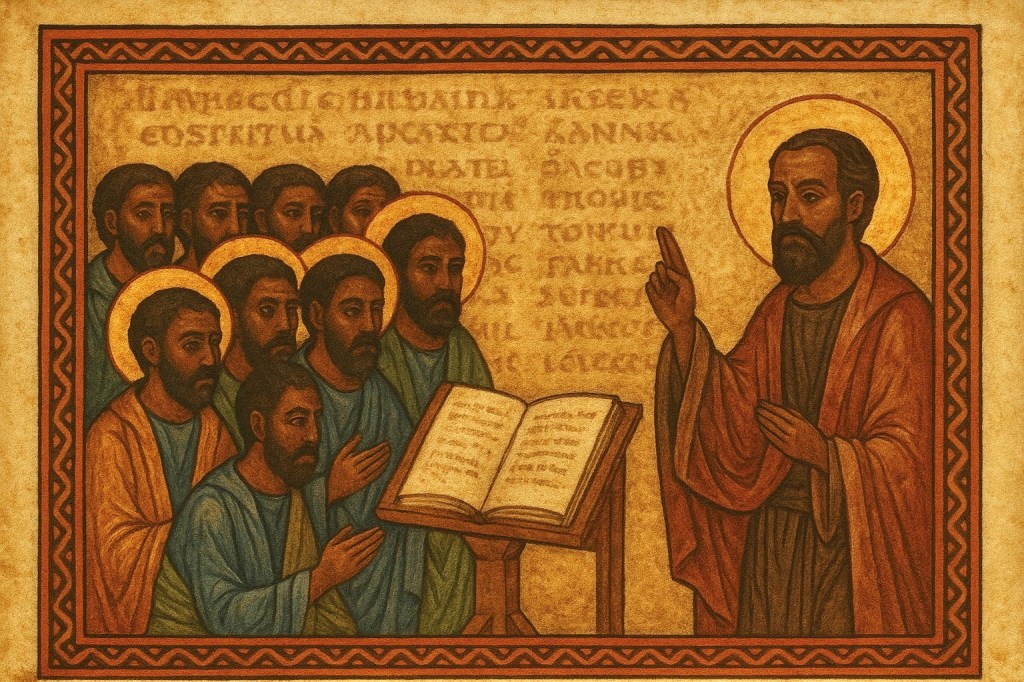
Can you imagine the Christian community today trying to agree on a biblical canon of the Scriptures?
It’s almost unthinkable. With thousands of man-made denominations and endless doctrinal divisions, it’s hard to envision unity on something so foundational. Yet the early Church — despite immense persecution, false teachings, and growing pains — did exactly that.
The unity of the early Church, preserved through apostolic authority and the guidance of the Holy Spirit, allowed Christians to discern and preserve the true canon of Scripture. Without that unity, there would be no Bible as we know it today.
The Gradual Birth of the Biblical Canon
The canon of the Bible didn’t appear overnight. It was a gradual process that unfolded over the first four centuries through Church councils and the discernment of early Church Fathers who safeguarded the apostolic faith.
Among them, one figure stands out as a cornerstone of unity and doctrinal clarity: Irenaeus of Lyons (130–202 AD).
Irenaeus: The Second-Century Defender of Unity
Born around 130 AD, Irenaeus of Lyons is regarded as one of the most influential Christian thinkers of the second century. His writings held the early Church together amid rising heresies and growing cultural hostility.
Through this work, Irenaeus demonstrated how Church doctrine developed through apostolic tradition and church authority, not through private interpretation or individual revelation.
For Irenaeus, nothing gained by reform or innovation could outweigh the destruction caused by schism — echoing Paul’s appeal in 1 Corinthians 1:10 for unity in mind and judgment.
“He will also judge those who bring about schisms… who consider their own advantage rather than the unity of the Church. They speak of peace but wage war.” — Irenaeus, Against the Heresies
He authored the monumental six-volume work Against the Heresies — a theological defense of apostolic truth and one of the foundational documents of Christian orthodoxy.
Christ’s Recapitulation of All Things
Irenaeus’ theology culminates in the idea of recapitulation — that Christ, the new Adam, “reverses” the disobedience of the first Adam and makes all things new (Revelation 21:5).
By assuming humanity, Christ restored it; by dying, He conquered death; by obeying, He undid Adam’s rebellion. In Irenaeus’ view, all history finds its meaning in Christ’s redemptive renewal of creation.
He very clearly affirmed and articulated the full deity of Jesus Christ. While he lived only a generation removed from the Apostles (through his teacher Polycarp, a disciple of John), Irenaeus wrote extensively against Gnostic teachers who denied that Christ was truly God in the flesh. His chief work provides some of the earliest, most systematic affirmations of Christ’s divinity in the post-apostolic Church.
Mary, the New Eve
In his teaching Mary Unties the Knot of Eve’s Disobedience, Irenaeus drew a profound comparison between Eve and Mary.
Just as the virgin Eve, after listening to an angel, brought death to humanity through disobedience, so the Virgin Mary, hearing the words of an angel, obeyed and brought life through her “yes.”
This became one of the earliest articulations of the doctrine of Mary as the New Eve, establishing a foundation for Christian theology and fulfilling Mary’s own prophecy:
“From now on, all generations will call me blessed.” — Luke 1:48
Mary as the Ark of the New Covenant
The early Church also venerated Mary as the Ark of the New Covenant, drawing typological parallels between the Old and New Testaments.
Just as the cloud overshadowed the Ark in Exodus 40:34–35, so the Holy Spirit overshadowed Mary in Luke 1:35 — both described by the same Greek word for “overshadow.”
This connection reinforced Mary’s role as the dwelling place of the Divine Word, prefigured in the Old Covenant and fulfilled in the New.
In Revelation 11:19 – 12:2, The Ark seen in heaven identified with a woman (Mary) “Then God’s temple in heaven was opened, and the Ark of his covenant was seen within his temple.” Immediately following: “And a great sign appeared in heaven: a woman clothed with the sun, with the moon under her feet, and on her head a crown of twelve stars.”
The original manuscripts had no chapter division—these verses flow together—so the “Ark seen in heaven” is closely associated with the “woman,” interpreted by the early Church as Mary, the Mother of the Messiah.
The Eucharist: Flesh and Blood of Christ
In On the Eucharist, Irenaeus confronted Gnostic teachings that denied Christ’s true humanity. He emphasized the Eucharist’s sacrificial character and insisted that it is truly the Body and Blood of Christ (John 6:51–58).
If Christ’s body were not real, he argued, neither could the Eucharist be real — making this one of the earliest and clearest affirmations of the Real Presence in early Christianity.
Truth and Apostolic Succession
In On Truth Contained in the Churches with Apostolic Succession, Irenaeus points to Rome’s apostolic authority as a safeguard of unity and truth.
He called it “the greatest and most ancient church, founded and built up by Peter and Paul.”
“With this Church, because of its greater authority, it is necessary that every Church should agree… for in her apostolic tradition has always been safeguarded by those who are everywhere.” — Against the Heresies, III.3.2
He lists the succession from Peter to Linus, Anacletus, and Clement, reminding readers that continuity of apostolic teaching — not innovation — was the measure of true faith.
“The Blessed apostles, therefore, having founded and built up the church, handed over Linus, the bishopric for administrating the church. In his epistle to Timothy, Paul mentions this Linus. Anacletus succeeded him; after him, in third place from the apostles, Clement acquired the bishopric. He both saw the blessed apostles themselves and conferred with them, and still had the preaching of the apostles ringing in his ears and their tradition before his eyes. In this way, he was not alone, for there were many others still left at the time would’ve been taught by the apostles.
“In this way, we confound all those who in any way whatever, either because of self complacency, or vainglory or a blindness, gather in unauthorized assemblies. For with this church, because of a greater authority, it is necessary that every church, that is, the faithful who are everywhere, should agree because in her apostolic tradition has always been safeguarded by those who are everywhere.”
It was under Clement that no small dissension arose among the brethren at Corinth. The church of Rome wrote a very forceful letter to the Corinthians, uniting them in peace, renewing their faith and proclaiming the tradition which it had but recently received from the apostles.”
*On Christ founding the church, the authority of the church and apostolic succession – Matthew 16:18-19, Matthew 18:18, 1 Timothy 3:15, and 2 Timothy 2:2 was seen by Irenaeus and the early church as the foundation for apostolic succession.
A Church That Would Not Divide
The miracle of the early centuries is not merely that the Church survived persecution — but that it remained one.
Through figures like Irenaeus, the early Christians guarded truth through unity, holding fast to apostolic authority and refusing to let division destroy what Christ had founded.
Without that unity, there would be no canon.
Without that canon, there would be no Bible.
Without the Bible, the faith itself would have no foundation.
Irenaeus stood firmly within that tradition, affirming that Christ founded one Church, entrusted with the mission to teach, preserve, and unify believers across generations.
 Echoes of the Fathers