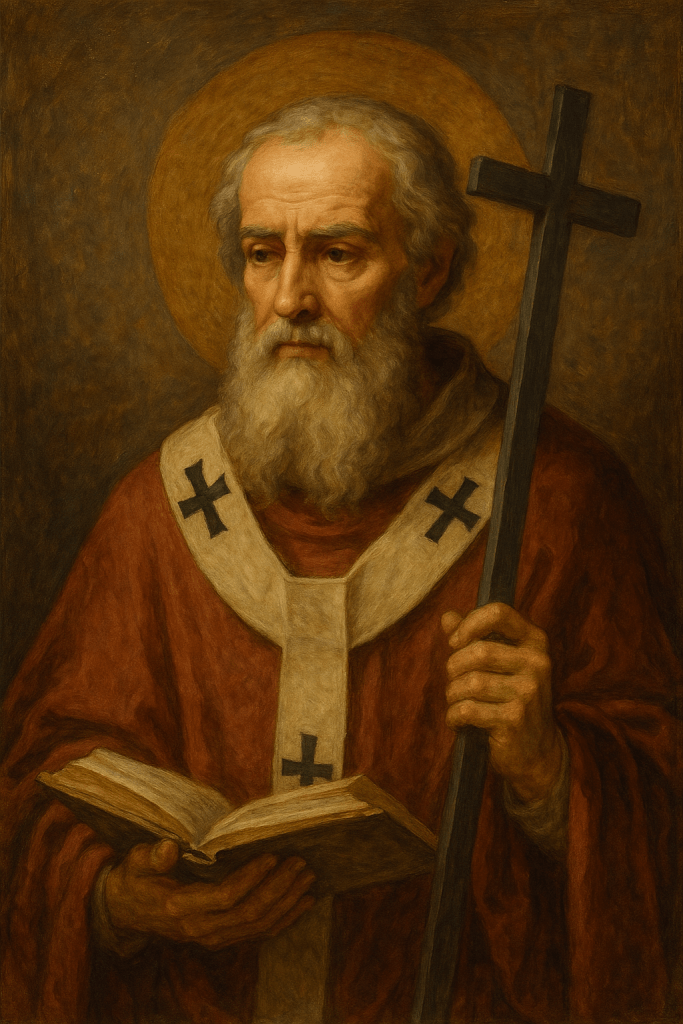
Another Church Father who I knew nothing about was Clement of Rome. And there’s no reason I shouldn’t have known anything about him. After all, along with Ignatius of Antioch—who I wrote about recently—he is one of the most significant figures of the early Church. Like Ignatius, who was discipled by John, Clement walked with and among the apostles, receiving the scriptures directly from them. He is thought to be the Clement mentioned in Philippians 4:3 as a faithful co-worker of Paul’s.
Clement was the fourth Bishop of Rome, where he served until being exiled in AD 97 before his martyrdom around 100 AD. He is best known as the author of 1 Clement, written around A.D. 95, which is the earliest surviving Christian document outside the New Testament. This letter, sent from the Church of Rome to the Church of Corinth, addressed issues of division and rebellion against church leaders. The Corinthian Christians had removed their leaders without cause and put others in place without the authority of the bishops. His decision to intervene in the affairs of the Corinthian church reveals an early expression of Roman primacy and the authority of the Bishop of Rome.
In 1 Clement, he strongly defended apostolic authority, emphasizing obedience to bishops and presbyters and teaching that church leaders were appointed by the apostles and should not be unjustly removed. According to Clement, Christ ordained the apostles (cf. John 20:21) and the apostles ordained their successors in ministry, a principle conveyed in passages like Acts 14:23 (appointing elders in every church) and 2 Timothy 2:2 (Paul instructing Timothy to entrust teaching authority to other faithful men).
We see this in Scripture when Jesus handed the keys of the Kingdom to Peter, giving him the power to bind and loose on earth and in heaven (Matthew 16:18–19). When you hand somebody the keys, you’re leaving them in charge until you come back. Peter likewise handed the keys to his successor as the Bishop of Rome, so forth and so on until this current day. We see this again when Jesus breathed on the apostles and gave them the authority to forgive or retain sins (John 20:22–23). Apostolic succession holds that the apostles likewise breathed on their successors, who breathed on their successors, continuing this lineage to the present day.
Clement also promoted unity, humility, repentance, and charity, urging Christians to avoid jealousy and division and to imitate Christ and the saints. His writing offers some of the earliest evidence for an established Church hierarchy, including bishops, presbyters, and deacons, which is exactly what we see in the New Testament (cf. Philippians 1:1, 1 Timothy 3:1–13, Titus 1:5–9) as well as for apostolic succession and liturgical order.
We see this church order throughout the New Testament and carrying on throughout early Church history, during the period of explosive growth when the Christian faith spread as one Church planting other churches under the authority of the universal (Catholic) Church. The New Testament churches were planted under the authority of the apostles (Acts 2:42, Acts 15:1–29), and the churches in the post-apostolic age were planted by their successors.
Clement also dealt with the issue of faith and works and justification, teaching that we are justified by faith (cf. Romans 5:1). But he immediately tied this faith to humility, obedience, and works of love (Matthew 25:31-46, I Corinthians 13:2). For Clement, faith and works were inseparably united: faith initiates salvation, but works demonstrate its reality (cf. Ephesians 2:8–10). His interpretation anticipates James’s insistence that we are not justified by faith alone, and that faith without works is dead (James 2:17, 24, 26). For the Church Fathers, and the early Church as a whole, salvation was always seen as a process – grace through faith, persevering by living out faith through love.
When disputes arose, they were always handled by the Church; Not individual, autonomous churches but the universal church as a whole, which aligned with scripture. Church disputes were settled by the apostles in the New Testament—most notably at the Council of Jerusalem in Acts 15. Disputes in the post-apostolic age were, and continue to be, settled by the successors of the apostles. All the while, the unity of the universal Church was held together by the apostles, their successors like Clement, and the hierarchical authority modeled in the New Testament and put in place by the bishops of the Church who succeeded the apostles and continue to hold that unity – in the universal (Catholic) Church – in place today.
 Echoes of the Fathers