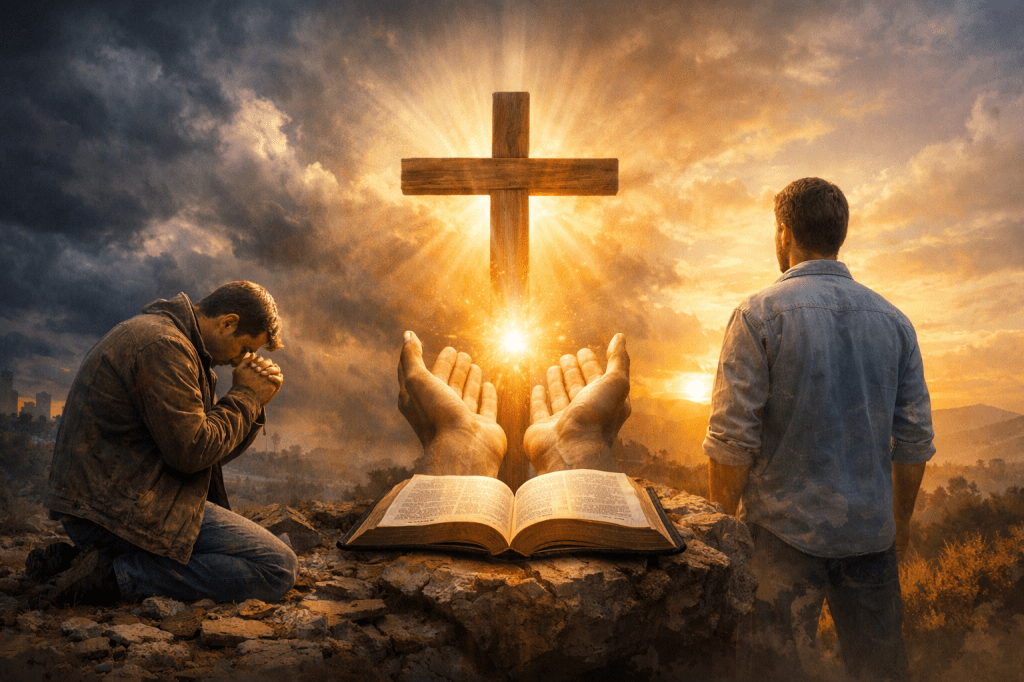
Ask 10 different Christians coming out any church on Sunday morning what the gospel is, and you’ll likely get multiple answers. Perhaps even 10 different answers. Some will be overly complex, and some too simplistic. The beauty of the gospel is that it’s both complex enough to satisfy the most educated of human beings. Yet simplistic enough for a child to understand.
At its core, the gospel is simply three-fold: Repent of our sins, Receive the good news of Jesus birth death and resurrection by grace through faith; and to Remain in Christ. We could look both to the scriptures, and the early Church that was handed the gospel directly from the apostles themselves to amplify, and expand upon what it means to repent, to receive and to remain.
From the beginning, the early church understood the gospel not as a single moment of decision, but as a participatory way of life—one that begins in repentance, is sustained by grace received through faith, and endures through abiding communion with Christ.
The gospel begins with repentance. Jesus’ earliest proclamation was a call to “repent and believe the gospel” (Mark 1:15), and the apostles echoed this summons as the doorway into new life.(Acts 2:38; 3:19). “Peter [said] to them, “Repent and be baptized, every one of you, in the name of Jesus Christ for the forgiveness of your sins; and you will receive the gift of the holy Spirit.” Repentance in Scripture is not mere remorse, but metanoia—a turning of the whole person from death toward God.
The earliest Christian writings reflect this same understanding. Clement of Rome speaks of repentance as a merciful gift continually extended by God. In the early church, repentance was both a decisive break with sin and a continual posture of returning to God, leading to renewal and “times of refreshing” promised in Christ.
Yet repentance is not the end of the gospel; it is the threshold. To receive the gospel, then, is not simply to accept forgiveness, but to enter into participation in the life of Christ. We receive the gospel, “by grace, through faith, not from works, to do the good works that God has prepared in advance, that we should live in them.” (Ephesians 2:8-10)
This life, once received, must be faithfully lived. Jesus’ command to “remain in me” (John 15:4) reveals that fruitfulness flows not from momentary belief but from enduring communion. The apostles consistently exhorted believers to remain steadfast, holding fast to the faith they had received. That we’ll be presented holy, without blemish, and irreproachable before him, provided that we persevere in the faith (Colossians 1:21–23; Hebrews 3:14), and the risen Christ Himself calls His people to faithfulness unto death (Revelation 2:10).
Paul goes on to say, “Now I am reminding you, brothers, of the gospel I preached to you, which you indeed received and in which you also stand. Through it you are also being saved, if you hold fast to the word I preached to you, unless you believed in vain.” 1 Corinthians 15:1-2
Thirty-six times in John’s Gospel, and his letters, does he tell us to remain or abide, while laying out the eternal consequences of not abiding or remaining. Every one of the parables speak to the need to persevere with the grace freely given to us, to bear fruit, to be ready and prepared for his coming with dire consequences of not doing so. This is not a works based gospel. It’s God who does the work in us and through us, we simply have to exercise the free will he’s given us to remain or abide in him.
The early church echoed this emphasis with clarity and urgency. Polycarp urged believers to persevere in obedience and hope, while Origen described the Christian life as continual progress toward Christlikeness. Cyprian emphasized that abiding in Christ could not be separated from abiding in His body, the Church. Remaining was not understood as passive maintenance, but as active participation in grace through Scripture, prayer, sacrament, and communal life. Seen through the witness of Scripture and the early church, the gospel takes on a clear and coherent shape.
We are called to repent—turning from sin and death toward God; to receive—entering into union with Christ by grace; and to remain—abiding faithfully in Him through persevering communion. Salvation is not reduced to a past decision nor sustained by human striving, but lived as an ongoing participation in the life of God.
 Echoes of the Fathers
Leave a comment