I always start every day and end each day in prayer, as well as reading scripture. Specifically, in asking the Holy Spirit to put me in the right frame of mind of looking at life through a positive, spirit-filled lens, I begin and end in prayer of thanksgiving for what the Lord has blessed with that day and in life.
On this Thanksgiving, I’m grateful for Amy, my wife of 25 years and our three children, a family who I love more than life itself. I’m grateful for my parents, who are still here to see the husband, father and man that God has molded me to become. I’m thankful for the community of friends that Amy and I have; as well as the group of men that God has blessed me with and encircled around me.
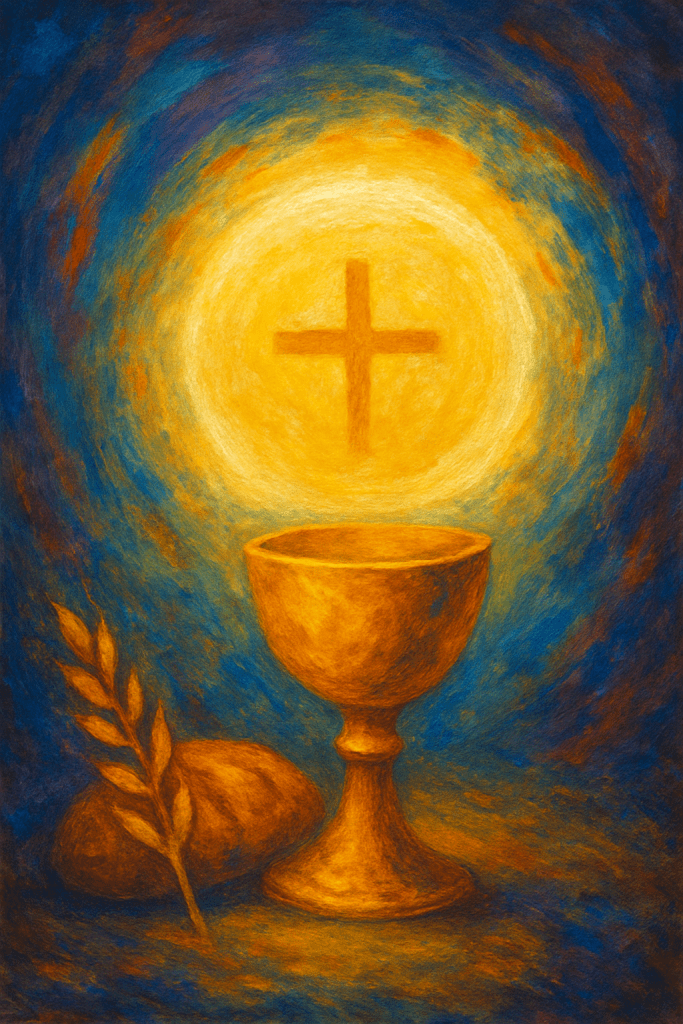
And this year, I’m extremely grateful for the Eucharist. Appropriately, Eucharist means thanksgiving and the eucharistic feast is the real presence of Jesus’ body and blood in the bread and wine at the altar or the communion table. In Luke 24:32, Jesus was walking with the disciples and their hearts were burning when he was explaining the scriptures to them. But it wasn’t until the breaking of the bread (Luke 24:30–31) where their eyes were fully opened.
This fits the experience for Amy and I the first 25+ years as Christians. We were energized by God’s word. We were burning with God’s word. But it wasn’t until the breaking of the bread for both of us, when we first desired the flesh of the Living Word as seekers, when eventually we partook in eating the flesh of the Living Word as converts where our eyes were fully opened. We had something as born-again believers, but not everything as we do now.
From a spiritual standpoint, there are different ways to encounter Christ. We encounter the Lord through scripture reading, prayer, worship, fellowship with other believers and service to others. But for us, there’s been no experience more powerful than in the holiness, stillness, reverence and worship of the Catholic Mass.
We’ve experienced this pouring out upon us firsthand, this power that we had never encountered before in our lives. Nothing has been more powerful than encountering Christ through the Real Presence in the Eucharist!
The purifying, sanctifying, cleansing and peaceful aspect of eating and absorbing the Lord has given us a deep-rooted level of peace and contentment that we’ve never felt. The Eucharist was the missing thread that we have been searching for our entire lives. We now experience the richness and fullness of daily reading the Bible again, where we had run dry, of prayer and worship again, where we had run dry, all strengthened and held together by the power of Christ’s Body and Blood that we receive at Mass. The fullness of Christ and our faith gives us the endurance, and strength to persevere through the multitude of life’s trials and tribulations.
We wish we had this fullness our entire lives, but our eyes were opened to what we didn’t know. We didn’t know that for the first 1500 years of Church history that everybody believed the bread and wine were the literal body and blood of Jesus.
We didn’t know that the altar with the Eucharist was at the center of church worship everywhere from the very first generations after the apostles until it was replaced by a pulpit in some sects the last 500 years.
We didn’t know that Ignatius of Antioch, who was discipled by John — the same John who wrote the Bread of Life discourse in John 6:22–71 — called the Eucharist the “medicine of immortality.”
We didn’t know that Justin Martyr, describing the Mass in A.D. 155–159, referred to the Eucharist after consecration by the priest as “not as common bread or common drink, but as the flesh and blood of Jesus Christ.”
We didn’t know that it was 500 years ago that a Swiss reformer named Ulrich Zwingli first advanced the theory that the bread and wine were symbolic.
We didn’t know that sola scriptura (scripture only) and sola fide (faith alone) were theological interpretations and doctrinal inventions of the 1500s and nowhere to be found amongst the Church Fathers, and the early Church.
We didn’t know that even Martin Luther believed in the Real Presence, that Luther believed Jesus meant what he said when he said, “This is my body… This is my blood” (Matthew 26:26–28; Mark 14:22–24; Luke 22:19–20).
We didn’t realize that we believed it was symbolic because we were told it was symbolic by those we looked up to; and we didn’t realize that you read into scripture what you want to be true, what you are told is true by those in authority whom you respect — not necessarily what is true. And therefore, we didn’t know that scripture very emphatically teaches that the bread is the body of Christ and the wine is the blood of Christ (John 6:51–58).
We didn’t know, because of the lens through which we read scripture, that six times in John 6 and in the Last Supper narratives Jesus says: “This IS my body… This IS my blood” (John 6:51–58; Matthew 26:26–28; Mark 14:22–24; Luke 22:19–20).
We didn’t know that Paul reaffirmed this in Corinthians when he recounts Jesus telling his disciples, “This is my body… This cup is the new covenant in my blood” (1 Corinthians 11:23–25).
We didn’t know scripturally and historically that the Eucharist is the New Testament fulfillment of the Holy of Holies — the place of God’s real presence (Hebrews 9:1–5; Hebrews 10:19–22).
We didn’t realize, through the interpretive lens through which we read scripture, the physical damage that Paul addresses to the Church in Corinth about taking the body and blood in an unworthy manner negates any symbolic interpretation (1 Corinthians 11:27–30).
We didn’t understand how one who takes communion in an “unworthy,” yet symbolic manner could be guilty of the body and the blood of the Lord (1 Corinthians 11:27) to the point that they were getting sick and dying if it is merely symbolic.
We didn’t realize that all the times we took communion in a symbolic fashion, we would have been deemed by every one of the Church Fathers and the early Church as taking the body and blood in an unworthy, heretical manner.
We didn’t realize that it was this altar that has kept the one, holy, catholic and apostolic Church together for 2000 years with all of its beauty and richness.
We didn’t know there was a Church that traced all its roots back to Jesus and the apostles (Acts 2:42; Ephesians 2:20).
We didn’t know there was a Church whose leader held the same keys that Jesus handed to Peter — giving him the authority to bind and loose on earth and heaven (Matthew 16:18–19).
We didn’t realize there was a Church whose leadership was breathed upon by their predecessors with the responsibility to forgive or retain sins — who themselves were breathed upon going back in an unbroken chain to the apostles. (John 20:21–23; 2 Timothy 1:6).
We didn’t know that in a crazy, chaotic world where nothing is constant, there is one Church that’s been around 2000 years and the gates of hell have not prevailed against it (Matthew 16:18).
We didn’t know that anywhere you go in the world, you could go to one of these churches and the worship — down to the scripture readings that day — will be exactly the same.
We didn’t know there was that much unity across 1.2 billion believers — unity centered around Christ at his altar where all believers are in communion with one another (1 Corinthians 10:16–17).
Ultimately though, everything is according to God’s plan and purpose (Romans 8:28). And if we had this our entire lives, maybe we would be like so many who take it for granted? We are thankful and blessed that God reached us the way he reached us to bring us into his Kingdom when we were in our 20s. We are very grateful for everything we experienced along the way, and we’re very thankful to be where we are now!
 Echoes of the Fathers
Leave a comment