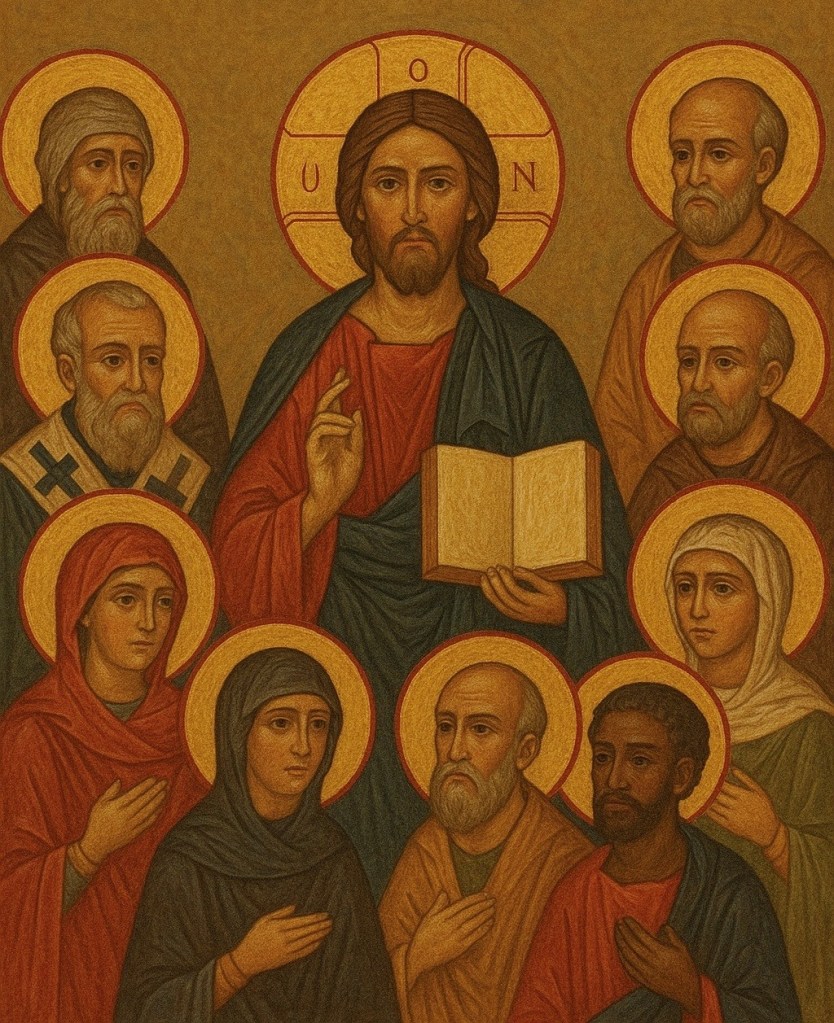
On All Saints Day, it’s important in venerating the Saints to understand why we honor and venerate those who came before us.
In the same way that great athletes, study other great athletes who came before them as role models, we study the saints and the lives they lived in fulfilling the Lord‘s plan, purpose and mission for their lives as examples to us; as we allow the Holy Spirit to work through us in fulfilling God‘s plan, purpose, and mission for our lives!
While this will be covered in more detail in a future post, the veneration of the Saints was customary in the early church among the church fathers on scriptural grounds. Clement of Rome, Ignatius of Antioch, Justin Martyr, Irenaeus, Tertullian, up through Jerome and Augustine just to name a few of the Fathers who showed veneration through prayers of intercession, and feast days.
And why wouldn’t they? If we’re surrounded by such a great cloud of witnesses (Hebrews 12:1) why wouldn’t we ask them to intercede for us? Especially when we know that biblically, they present our requests to the Lord (Rev 5:8, Rev 8:3-4)
For if we would ask our closest friends, and those we know who love and serve the Lord to pray for us. How much more should we be asking those who live in heaven, and close to Lord to in intercede for us in prayer?
The early Church venerated the saints, beginning with martyrs and later extending to other holy figures. This veneration was seen as an expression of the communion of saints — the unity of the Church on earth with those already in heaven — and was always distinguished from the worship owed only to God.
If living Christians are urged to intercede for one another, how much more could the righteous in heaven — now perfected and closer to God — pray for those still on earth? The early Fathers viewed prayer to the saints as a natural extension of the intercessory communion already practiced among believers.
On why we should commemorate, study and honor of the Saints, Ronda Chervin – a convert from Judaism, professor of philosophy and theology – said it best on why we venerate the Saints:
“The saints are the great revolutionaries in the area of loving God and neighbor. Through their total commitment to God, they are able to extend themselves past the boundaries of what their own society is willing to see as lovable….
Saint Vincent de Paul discovered the lovableness of slaves and of abandoned babies. And different saints through the centuries overcame the lethargy of their fellow citizens by expanding enormous energies in the founding of the first free hospitals and schools for the poor.
In more recent times we have Saint Thérèse of Lisieux, who found ways to turn the most trivial occupations into gifts of love, thus bringing Christ closer to the limited bourgeois class to which she belonged.
Saint John Bosco, relying solely on daily contributions, was able to feed, clothe, shelter, and train hundreds of street boys in Northern Italy.
And a missionary nun, Mother Teresa, worked in the teeming streets of Calcutta, gathering up those dying in rags to care for and assure them that at least in their last moments of life they are loved and wanted. The list of saints and their deeds of love is endless….
If we are really interested in the happiness of those closest to us, can we ignore the depth of love which the saints show us is possible through total commitment to Christ?
We should want to imitate them, not because of some vainglorious desire to be famous, but because we wish to give ourselves generously to those who need us. But we cannot do this unless we become holy (totally open to Christ); only then, through love, can we give them something of infinite and eternal value….
Because of the radiance of those personalities who love totally, we find them as lovable as people we know personally, and therefore call on their help as participants in Christ’s inner life of grace with trusting confidence. By relating to them we get a foretaste of the final union of all mankind in Christ’s Mystical Body. One day we shall arrive in eternity where we shall dance together in the sheer joy of perfect love.”
 Echoes of the Fathers
Leave a comment